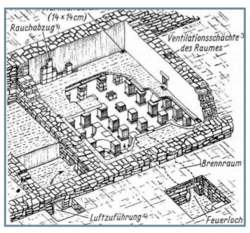
The hypocaust

hypocaust
The pioneer of underfloor heating — the Roman Hypocaust dates from over 2000 years ago.

This underfloor heating system is said to have been devised by the Roman Sergius Orata in about 80 BC and was described by Vitruvius in his book De Architectura in 16 BC. Hypocaust heating was used by the Romans in their villas throughout the colder climates in Europe and Britain as they expanded their Empire. This was the first widespread central-heating system and remained in use throughout much of Europe for over 400 years. It is, at last, enjoying a revival. There were three kinds of hypocaust. • Floor heating only • Heating via floors and walls • Warm-air system in which the air was admitted to the room through holes in the floor. (Does that sound familiar?) In the earliest form, the floor of the room was supported on pillars less than a metre high, which many of us see when we visit Roman sites where the walls and floors have been destroyed, leaving the familiar stacks of tiles or bricks. Part of the space below the floor served as a furnace chamber, with the fire stoked through a hole in the external wall. The hot gases circulating below the floor warmed it. Around the second century AD, the hypocaust pillars were abandoned, and smoke ducts were formed in the subfloor, radiating from the furnace and connected to wall flues (by the earliest ductwork contractors?). Fine examples of the hypocaust can still be seen in Britain at Chester, Bath, and Chedworth Villa in Gloucestershire. There are also hypocaust remains at Rockbourne Villa in Hampshire, in Newport Villa on the Isle of Wight, and at the Fort of Chesters on Hadrian’s Wall.


modbs tv logo

Baxi survey reveals care home leaders need support to achieve heat decarbonisation goals

Baxi recently surveyed over 400 senior and middle management care home managers in both the private and public sector this summer in an effort to understand the enablers required to help decarbonise the sector.

CIBSE launches Society of Vertical Transportation to elevate standards worldwide

CIBSE has officially launched the Society of Vertical Transportation (SoVT), an international professional community for individuals and organisations working across the design, engineering, installation and innovation of lifts, escalators and emerging vertical mobility systems.