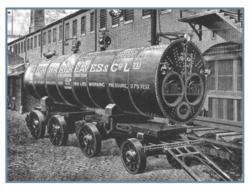
Lancashire boiler

Lancashire boiler
An unqualified success in efficient steam generation — the Lancashire boiler was in common use for over a hundred years.

In 1698, Savery produced a steam boiler to operate ‘The miner’s friend’, a water pump used in mines. In 1705, Newcomen and Cauley designed a boiler to drive Newcomen’s steam engine. By 1725 the Haystack and Wagon boilers were in common use and held their place for the next 70 years or so. They all had one thing in common. They were inefficient because the boiler sat above the fire, and much of the heat and hot gases never came into contact with the water-backed surfaces. The real breakthrough came in 1803 when Richard Trevithick introduced the internally fired Cornish boiler with a single internal flue running centrally through the length of a horizontal cylinder (the boiler shell). This design became known as a furnace-tube boiler, and wholesale manufacture seems to have started around 1810. However, the growth of British industry, particularly the demands of the Lancashire cotton industry, led for calls for larger and more powerful boilers. The problem was neatly solved by William Fairbairn (later Sir) at his Manchester factory. In 1855, he modified the Cornish boiler design by making it longer and of larger diameter. Importantly, he provided two smoke tubes to create the Lancashire steam boiler. The Lancashire boiler was an unqualified success, and it was manufactured in the thousands by many companies and shipped around the world for both heating and process applications. It remained in common use for over the next hundred years, and many examples survive today.


modbs tv logo

ICOM celebrates Noah Gaunt as Apprentice of the Year 2026

Noah Gaunt of Vaillant Group UK has been named ICOM’s Apprentice of the Year 2026, recognising his outstanding commitment, technical excellence and passion for advancing the future of low carbon heating.

BCIA warns non-domestic buildings risk being overlooked despite decarbonisation drive

Commercial and public buildings risk being left behind in the UK’s transition to Net Zero despite more than £40 billion of funding, investment and policy support being directed towards building decarbonisation, according to the latest Policy Pulse report from the Building Controls Industry Association (BCIA).