


Vent-Axia adds more power to MVHR range
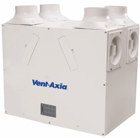
The Sentinel Kinetic High Flow MVHR (mechanical ventilation with heat recovery) unit from Vent-Axia is suited to larger homes and multiple-occupancy units such as care homes and student accommodation. This addition to the range means the company can offer MVHR solutions from small apartments up to light commercial.
The design is based on a high-efficiency backward-curved impeller with a specific fan power as low as 0.65 W/l/s.
Airflow is up to 175 l/s at 150 Pa with nearly 90% heat recovery. The fully automatic capability of the Kinetic range means effective ventilation is always achieved.
The 180/200 mm spigots can be positioned to give horizontal connection or a combination of vertical and horizontal connection. The folding filter can be easily removed, even when access is restricted. The integrated digital controller makes for simple and accurate commissioning.
There are multiple plug-and-play control options and BMS connectivity. Sensor inputs allow boosting from a full range of Vent-Axia controllers —including humidistats, Vent-Wise and timers, as well as a wireless remote. Switched live is available for boosting via light switches and has a delay-on and delay-off feature.
A programmable summer bypass operates when the internal temperature rises above a preset level. In winter, frost protection prevents frost building up on the intake side of the heat exchanger.